
Warmer floors, drier crawl spaces
Crawl Space Insulation in Beaverton, OR
Fix the ground cover and moisture first, then install insulation that stays in contact with the floor.
- Free on-site estimates with an attic and crawl space check
- Written, itemized quotes listing R-value, depth and square footage
- Air sealing and ventilation checked before insulation goes in
Cold Floors Usually Start Under the House
Crawl space insulation matters more in Beaverton than many homeowners expect. A lot of the city's ranches, split-levels and two-story homes sit over vented crawl spaces, and from November through February the air down there is cold and wet. If the floor above is uninsulated, or the batts have fallen, you feel it in cold floors, drafty rooms and higher heating bills. If the ground is not covered, moisture from the soil adds a musty smell and can soak whatever insulation is left.
What we usually find
- Fiberglass batts between the floor joists that have sagged or dropped onto the ground
- Torn, bunched or missing plastic ground cover
- Standing water after heavy rain, often from downspouts or grading
- Ducts that are disconnected or uninsulated
- Rodent nests in the batts and droppings on the ground cover
- Open rim joists along the foundation
Each of these affects how insulation will perform, so the estimate starts with a full crawl through the space when access allows.
Ground cover first
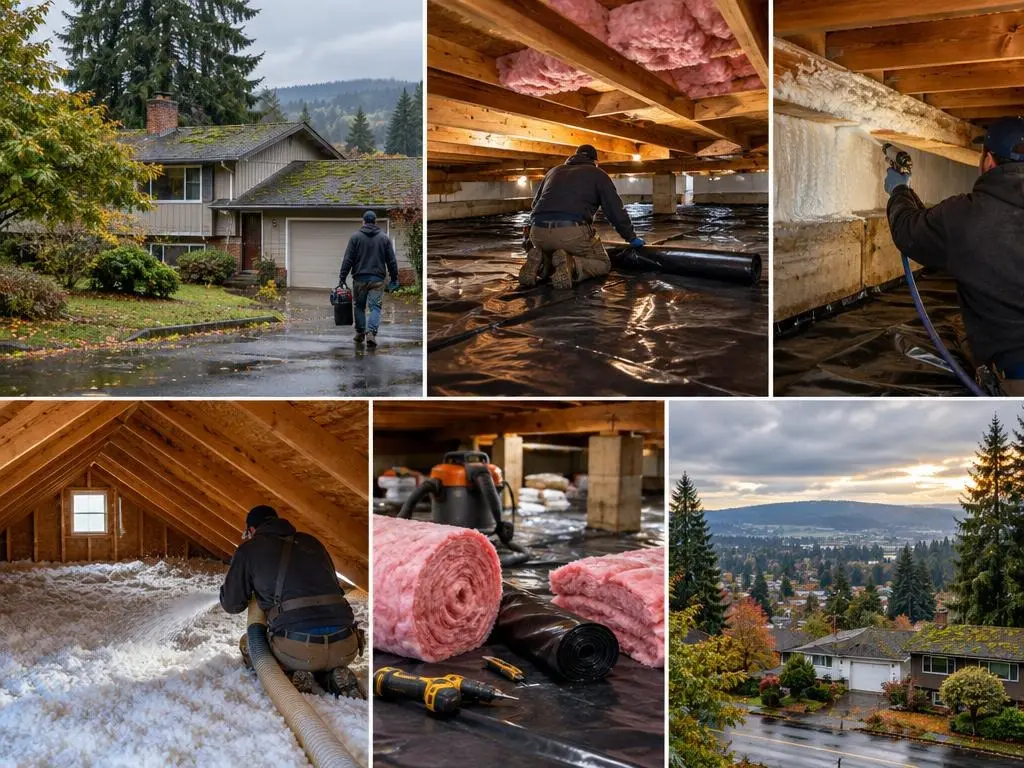
In a vented crawl space, a continuous ground cover of polyethylene sheeting keeps soil moisture from evaporating into the space. We remove damaged plastic and debris, lay new sheeting with overlapped seams, and run it up the foundation walls where needed. Standing water is a separate problem; if water collects after storms, the source (downspouts, grading or a high water table) needs to be dealt with, and we tell you that before insulating.
Insulating the floor
For a vented crawl space, the insulation goes in the floor framing, against the subfloor. The current Oregon code calls for R-30 under floors in new construction, and the Department of Energy suggests R-30 for an uninsulated floor in our climate zone. Batts only work if they stay in full contact with the subfloor, so we hold them up with wire supports or netting rather than relying on friction. Where framing is irregular or plumbing and ducts are in the way, rigid foam board or closed-cell spray foam can do a better job.
Rim joists and ducts
The rim joist is the band of framing that sits on the foundation all the way around the house. It is often the biggest air leak in the crawl space. We seal and insulate it with closed-cell foam or cut-to-fit foam board sealed at the edges. If ducts run through the crawl space, we note any disconnected or crushed runs; reconnecting and insulating them is usually worth doing while we are under the house.
Vented or encapsulated
An encapsulated crawl space is sealed from outside air, with a heavy liner on the ground and walls and insulation on the foundation walls instead of the floor. It can make sense for some homes, especially where ducts and equipment are in the crawl space, but it costs much more and changes how the space has to be ventilated or conditioned. HomeGuide lists encapsulation at $3,000 to $15,000. For most Beaverton homes, a good ground cover, a properly insulated floor and sealed rim joists solve the problem for far less.
Rodents under the floor
If mice or rats have nested in the batts, the contaminated insulation is removed and bagged, and the area is sanitized before new insulation goes in. Openings around pipes and vents should be sealed so they do not move back in; we can coordinate with your pest control company.
What This Covers
Crawl space work covers the ground, the floor framing and the edges of the foundation.
Ground cover replacement
Damaged plastic removed and new polyethylene sheeting laid with overlapped seams.
Underfloor insulation
Batts held tight to the subfloor with supports, or foam board where framing is irregular.
Rim joist sealing
Closed-cell foam or sealed foam board along the band joist.
Old insulation removal
Fallen, wet or rodent-soiled batts bagged and removed.
Typical Crawl Space Insulation Costs
| Item | Published national range |
|---|---|
| Typical crawl space job | $500 to $3,700 (HomeGuide); $500 to $6,000 (Fixr) |
| Batts between floor joists, per sq ft | $0.90 to $1.40 (HomeGuide); $1 to $2 (Fixr) |
| Rigid foam board, per sq ft | $1.20 to $3.70 |
| Closed-cell spray foam, per sq ft | $2.00 to $5.00 |
| Vapor barrier / ground cover | $1,200 to $4,000 (HomeGuide); $1,500 to $4,000 (Fixr) |
| Old insulation removal, per sq ft | $0.75 to $2.00 |
Published national ranges from HomeGuide (2026) and Fixr (2025). Crawl space height, access, moisture and cleanup change the total. Your written estimate sets the price.
How It Works
1. Crawl the space
We check the ground cover, moisture, existing insulation, ducts, rim joists and rodent signs.
2. Clear and cover
Old insulation and debris come out and new ground cover goes down.
3. Insulate
Floor insulation is installed and supported; rim joists are sealed.
4. Photo walk-through
You get photos of the finished space, since few people want to crawl in to look.
Crawl Space Insulation Questions
How much does crawl space insulation cost?
HomeGuide's 2026 guide puts most crawl space insulation jobs at $500 to $3,700, with a national average near $1,800. New ground cover adds roughly $1,200 to $4,000, and full encapsulation runs $3,000 to $15,000. We price your crawl space after inspecting it.
Why does the insulation under my house keep falling down?
Batts pushed between floor joists without support sag over time, especially when they absorb moisture. We hold insulation in place with wire supports or netting and fix the moisture source.
Should I encapsulate my crawl space?
Not always. Encapsulation can help where ducts and equipment are in the crawl space or moisture is severe, but it costs far more. Many Beaverton homes do well with a new ground cover, insulated floor and sealed rim joists.
What R-value should my crawl space floor have?
Oregon's residential code calls for R-30 under floors in new construction, and the Department of Energy suggests R-30 for an uninsulated floor in our climate zone. Framing depth sometimes limits what fits, which we note on the quote.
Crawl Space Insulation Service Areas
- Insulation Contractors in Beaverton, OR
- Insulation Contractors in Hillsboro, OR
- Insulation Contractors in Tigard, OR
- Insulation Contractors in Portland, OR
- Insulation Contractors in Lake Oswego, OR
- Insulation Contractors in Aloha, OR
- Insulation Contractors in Tualatin, OR
- Insulation Contractors in Sherwood, OR
- Insulation Contractors in West Linn, OR
- Insulation Contractors in Forest Grove, OR
- Insulation Contractors in Cornelius, OR
- Insulation Contractors in King City, OR
- Insulation Contractors in Bethany, OR
- Insulation Contractors in Cedar Mill, OR
- Insulation Contractors in Garden Home-Whitford, OR
- Insulation Contractors in Wilsonville, OR
- Insulation Contractors in Happy Valley, OR
- Insulation Contractors in Oregon City, OR
Get a Crawl Space Insulation Estimate
Free crawl space insulation estimates in Beaverton.